Grid-Aware Energy Orchestration for AI Data Centers
Grid-Aware Energy Orchestration for AI Data Centers
Grid-Aware Energy Orchestration for AI Data Centers
A.I.M.I.® EPMS coordinates grid signals, site electrical capacity, and compute demand in real time, translating energy strategy into bounded, logged control actions without compromising uptime.
A.I.M.I.® EPMS coordinates grid signals, site electrical capacity, and compute demand in real time, translating energy strategy into bounded, logged control actions without compromising uptime.
A.I.M.I.® EPMS coordinates grid signals, site electrical capacity, and compute demand in real time, translating energy strategy into bounded, logged control actions without compromising uptime.
Schedule a Demo
Power Flexibility in Practice
Power Flexibility in Practice
Power Flexibility in Practice
A.I.M.I.® EPMS (Energy & Power Management System) enables AI data centers to operate as grid-aware infrastructure rather than static electrical load.
As outlined in our Power Flexibility article, modern AI facilities face interconnection delays, peak pricing windows, demand response requirements, and carbon constraints that increasingly define when and how compute can run.
Power flexibility is not achieved through monitoring alone. It requires coordinated action across grid signals, electrical assets, and workload demand.
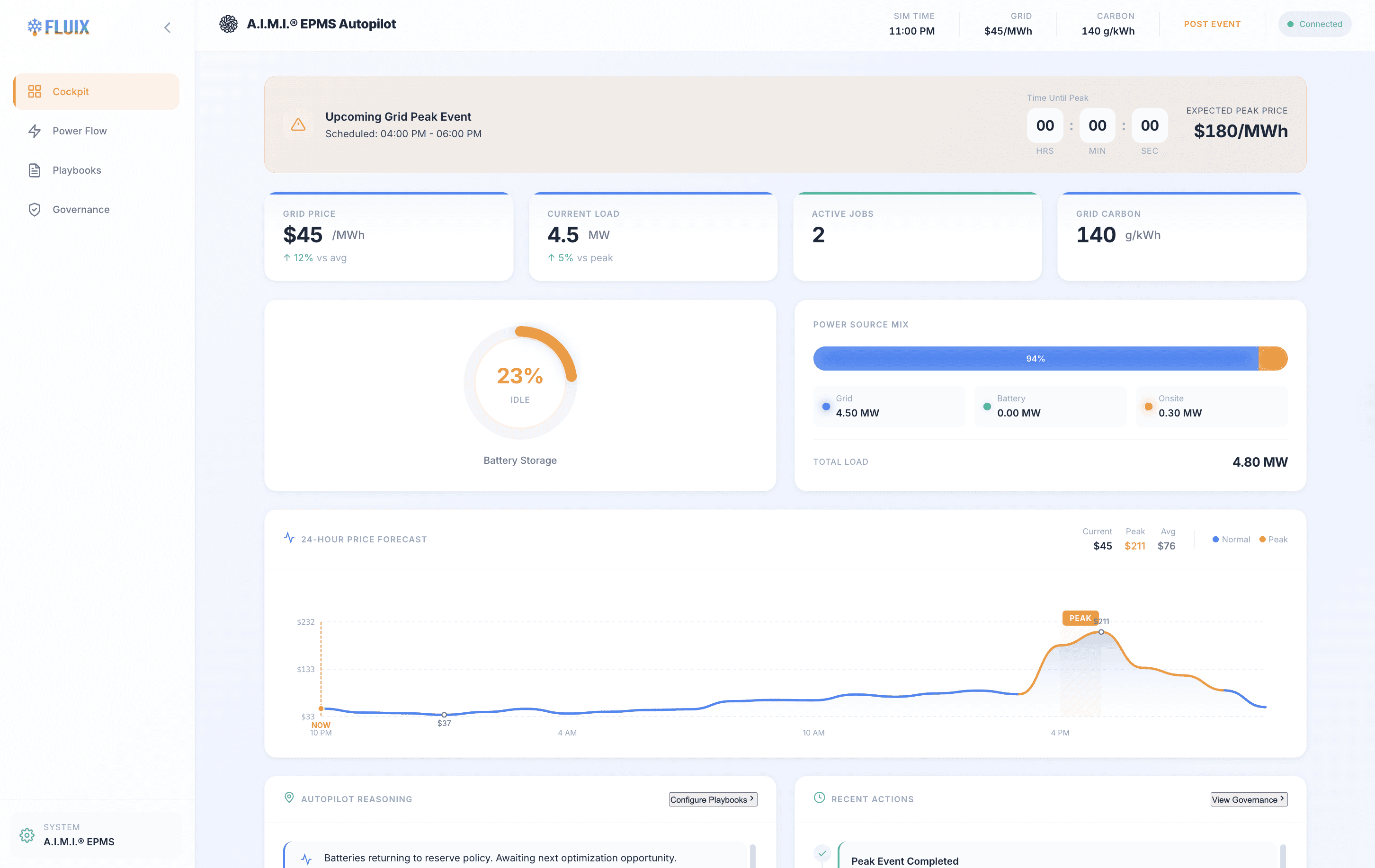
A.I.M.I.® EPMS translates energy strategy into deterministic, bounded control behavior — pre-charging batteries before peak events, minimizing grid draw during constrained windows, staging generation assets, and shaping eligible load in real time.
Flexibility becomes operational.
A.I.M.I.® EPMS (Energy & Power Management System) enables AI data centers to operate as grid-aware infrastructure rather than static electrical load.
As outlined in our Power Flexibility article, modern AI facilities face interconnection delays, peak pricing windows, demand response requirements, and carbon constraints that increasingly define when and how compute can run.
Power flexibility is not achieved through monitoring alone. It requires coordinated action across grid signals, electrical assets, and workload demand.
A.I.M.I.® EPMS translates energy strategy into deterministic, bounded control behavior — pre-charging batteries before peak events, minimizing grid draw during constrained windows, staging generation assets, and shaping eligible load in real time.
Flexibility becomes operational.
A.I.M.I.® EPMS (Energy & Power Management System) enables AI data centers to operate as grid-aware infrastructure rather than static electrical load.
As outlined in our Power Flexibility article, modern AI facilities face interconnection delays, peak pricing windows, demand response requirements, and carbon constraints that increasingly define when and how compute can run.
Power flexibility is not achieved through monitoring alone. It requires coordinated action across grid signals, electrical assets, and workload demand.
A.I.M.I.® EPMS translates energy strategy into deterministic, bounded control behavior — pre-charging batteries before peak events, minimizing grid draw during constrained windows, staging generation assets, and shaping eligible load in real time.
Flexibility becomes operational.
Watch How EPMS Works
Watch How EPMS Works
Watch How EPMS Works
How Grid-Aware Power Orchestration Works
Three coordinated control mechanisms are executed in real time within A.I.M.I.® EPMS.
How Grid-Aware Power Orchestration Works
Three coordinated control mechanisms are executed in real time within A.I.M.I.® EPMS.
How Grid-Aware Power Orchestration Works
Three coordinated control mechanisms are executed in real time within A.I.M.I.® EPMS.

Grid Signal Orchestration
Grid Signal Orchestration
Problem Today
Data centers receive price signals, congestion alerts, demand response notifications, and carbon intensity data, but response is manual, delayed, or disconnected from electrical asset state.
Problem Today
Data centers receive price signals, congestion alerts, demand response notifications, and carbon intensity data, but response is manual, delayed, or disconnected from electrical asset state.
How A.I.M.I.® Works
A.I.M.I.® EPMS continuously ingests grid signals and evaluates them against site electrical capacity and policy constraints. It triggers bounded actions such as battery dispatch, generator staging, and grid draw targets, all within defined autonomy envelopes.
How A.I.M.I.® Works
A.I.M.I.® EPMS continuously ingests grid signals and evaluates them against site electrical capacity and policy constraints. It triggers bounded actions such as battery dispatch, generator staging, and grid draw targets, all within defined autonomy envelopes.
Electrical Asset Coordination
Electrical Asset Coordination
Problem Today
Batteries, generators, UPS systems, and grid draw are typically governed by static thresholds and isolated control logic. Peak shaving becomes blunt. Chargeback windows require manual intervention. Assets operate independently rather than as a unified system.
Problem Today
Batteries, generators, UPS systems, and grid draw are typically governed by static thresholds and isolated control logic. Peak shaving becomes blunt. Chargeback windows require manual intervention. Assets operate independently rather than as a unified system.
How A.I.M.I.® Works
It anticipates peak events, pre-charges batteries, stages generation assets before stress windows, and minimizes grid draw during constrained periods, without overriding PLCs or safety interlocks. Electrical infrastructure behaves as a coordinated system rather than a collection of devices.
How A.I.M.I.® Works
It anticipates peak events, pre-charges batteries, stages generation assets before stress windows, and minimizes grid draw during constrained periods, without overriding PLCs or safety interlocks. Electrical infrastructure behaves as a coordinated system rather than a collection of devices.


Compute-Linked Power Flexibility
Compute-Linked Power Flexibility
Problem Today
IT load is treated as fixed demand even when certain workloads are deferrable or throttle-capable. This limits participation in demand response programs and reduces interconnection flexibility. Electrical constraints and compute behavior remain siloed.
Problem Today
IT load is treated as fixed demand even when certain workloads are deferrable or throttle-capable. This limits participation in demand response programs and reduces interconnection flexibility. Electrical constraints and compute behavior remain siloed.
How A.I.M.I.® Works
A.I.M.I.® EPMS integrates with A.I.M.I.® compute orchestration APIs to align workload flexibility with electrical constraints. During grid stress or pricing windows, eligible workloads can be shaped or shifted while preserving SLA boundaries. Power strategy and compute execution operate as a unified control system. This converts rigid electrical demand into controllable flexibility.
How A.I.M.I.® Works
A.I.M.I.® EPMS integrates with A.I.M.I.® compute orchestration APIs to align workload flexibility with electrical constraints. During grid stress or pricing windows, eligible workloads can be shaped or shifted while preserving SLA boundaries. Power strategy and compute execution operate as a unified control system. This converts rigid electrical demand into controllable flexibility.
Grid-Aware Power Orchestration, Explained
Grid-Aware Power Orchestration, Explained
This walkthrough demonstrates how A.I.M.I.® EPMS evaluates grid signals, site electrical state, and workload flexibility in real time, then executes bounded, logged control actions across batteries, generators, and grid draw.
Rather than monitoring dashboards, EPMS translates energy strategy into deterministic orchestration behavior.
This walkthrough demonstrates how A.I.M.I.® EPMS evaluates grid signals, site electrical state, and workload flexibility in real time, then executes bounded, logged control actions across batteries, generators, and grid draw.
Rather than monitoring dashboards, EPMS translates energy strategy into deterministic orchestration behavior.
Talk to the A.I.M.I.® Power Flex Team
Get a quick response from our team on deployment fit, requirements, and next steps.
Talk to the A.I.M.I.® Power Flex Team
Get a quick response from our team on deployment fit, requirements, and next steps.
Schedule a Demo
Schedule a Demo
Schedule a Demo