Power Flexibility: Turning Data Centers Into a Grid-Aware and Flexible Assets
Is Power the Limiting Factor for Data Centers?
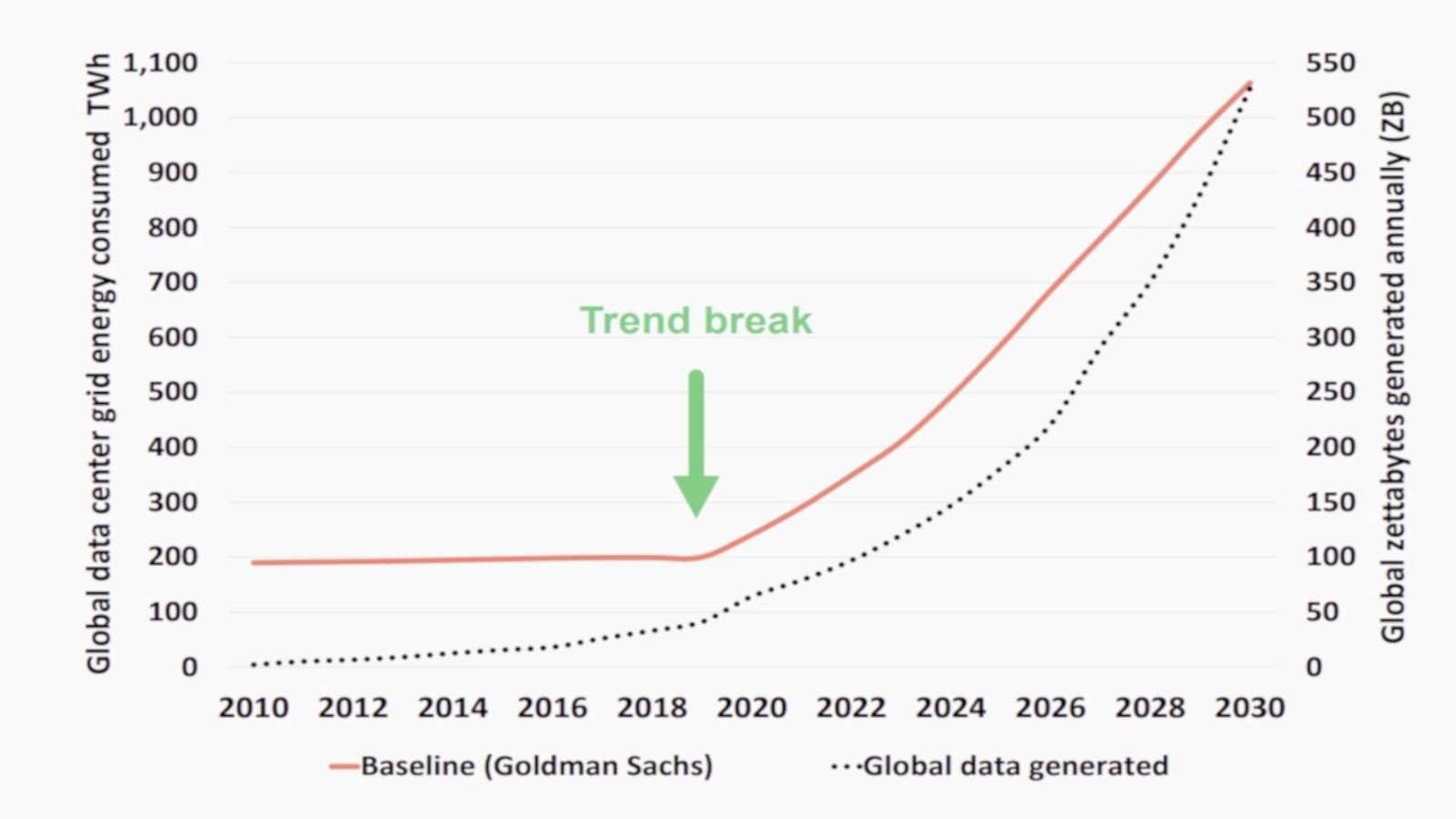
AI data centers are no longer constrained by compute alone. Power delivery, electrical headroom, and load ramp behavior have become first-order limits on growth, especially as “the number of high-density racks is increasing to support compute-intensive workloads” and power systems have to absorb faster step-changes in demand. [4] Ten Years ago, a data center's performance was limited by access to compute resources (GPUs, servers, IT equipment); now the burden is on the grid and onsite power to pick up the slack as data centers can pack in much more powerful compute at almost half the rack space.
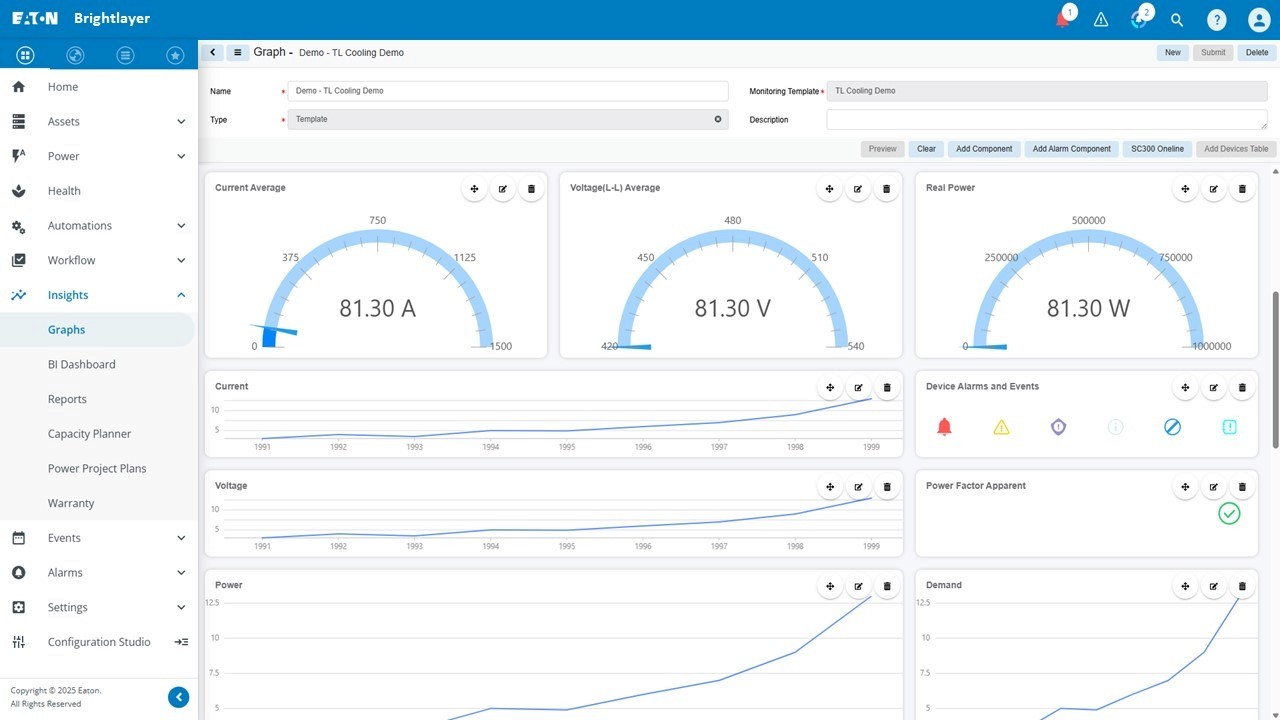
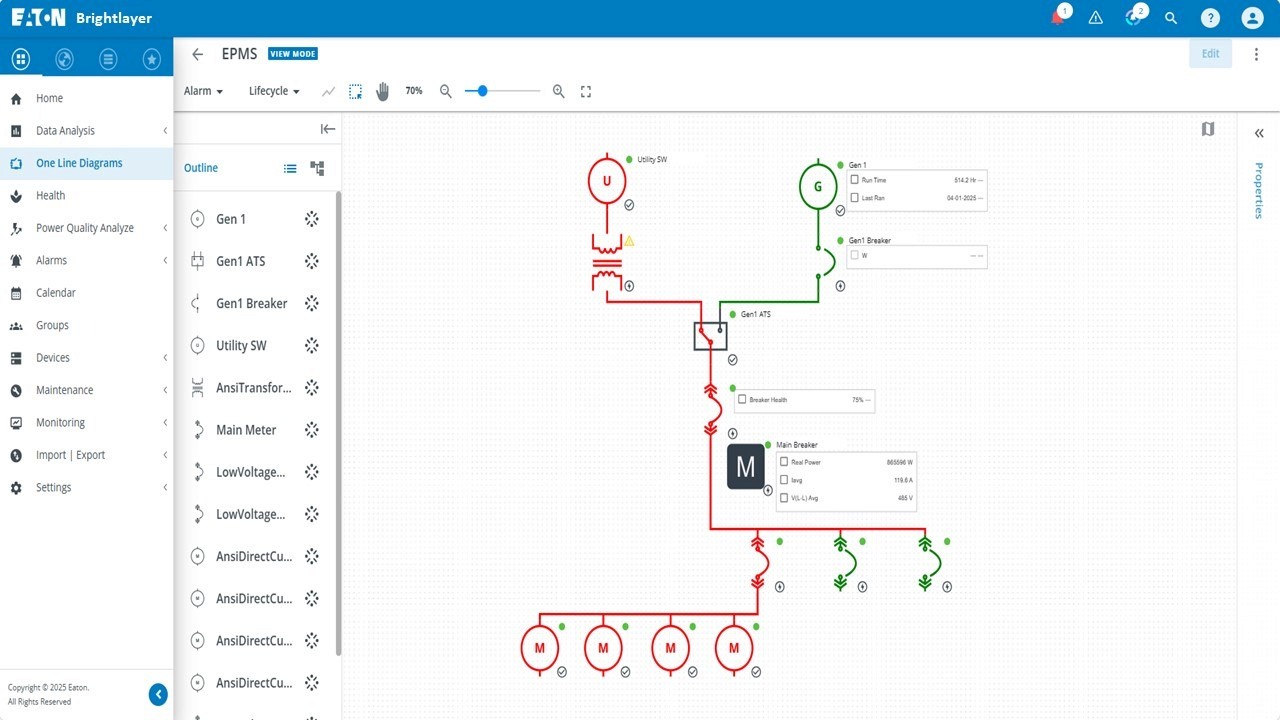
Historically, Electrical Power Monitoring Systems (EPMS) were designed for visibility and protection, not adaptability. They measured load, captured power quality events, and ensured breakers and feeders stayed within operating limits, but their job was fundamentally to help humans see what was happening and respond, not to coordinate facility-wide behavior minute by minute. The gap between monitoring and coordinated action shows up most clearly in how traditional stacks treat electrical infrastructure as something that should be stable, conservative, and rules-bound, even while the grid and the workload become dynamic.
Historically, Electrical Power Monitoring Systems (EPMS) were designed for visibility and protection, not adaptability. They measured load, captured power quality events, and ensured breakers and feeders stayed within operating limits. But their job was fundamentally to help humans see what was happening and respond, not to coordinate facility-wide behavior minute by minute.
The gap between monitoring and coordinated action shows up most clearly in how traditional stacks treat electrical infrastructure as something that should be stable, conservative, and rules-bound, even while the grid and the workload become dynamic.
However, there is a new concept called data center flexibility. From the viewpoint of the grid, a data center can adapt how much power it uses. This is typically done through energy efficiency (i.e., eliminating wasted energy from cooling as referenced in [8], using AI to optimize cooling control in data center environments) or demand response (i.e., optimizing workload management by time-shifting, relocating, or throttling workloads [9]).
Although these methods help reduce data center load on the grid, they are one layer removed. Meaning, there is a more direct optimization of power systems that can directly help alleviate load from the grid, while ensuring data center operations are not impacted. This is called Power Orchestration, and it can be done through the use of a tool called an Electrical Power Monitoring System (EPMS). The concept of this article is to introduce a new type of tool that moves from just observing to actively and autonomously participating in optimizing and supervising electrical equipment, an AI EPMS.
 |  |
The assumption of data centers being rigid loads no longer holds true.
AI workloads introduce faster, larger, and less predictable load ramps. In parallel, utilities are tightening interconnection requirements, enforcing ramp-rate constraints, and penalizing inflexible behavior through demand charges and operational limits. Power flexibility is no longer optional; it is becoming operationally necessary.
The Gap Between EPMS and Grid Reality
Most EPMS platforms answer one question extremely well: what is happening right now.
They were never designed to answer the more important one: what should happen next.
Inside a modern data center, electrical infrastructure spans substations, switchgear, UPS systems, batteries, generators, and increasingly microgrids. Each layer enforces its own constraints, typically through local control logic. EPMS aggregates telemetry across these layers, but decision-making remains fragmented and conservative, partly because even “the most advanced BMS packages fall short of what a true electrical power management system can do,” and even EPMS itself is often positioned more as forensics and reporting than as a supervisory brain. [1]
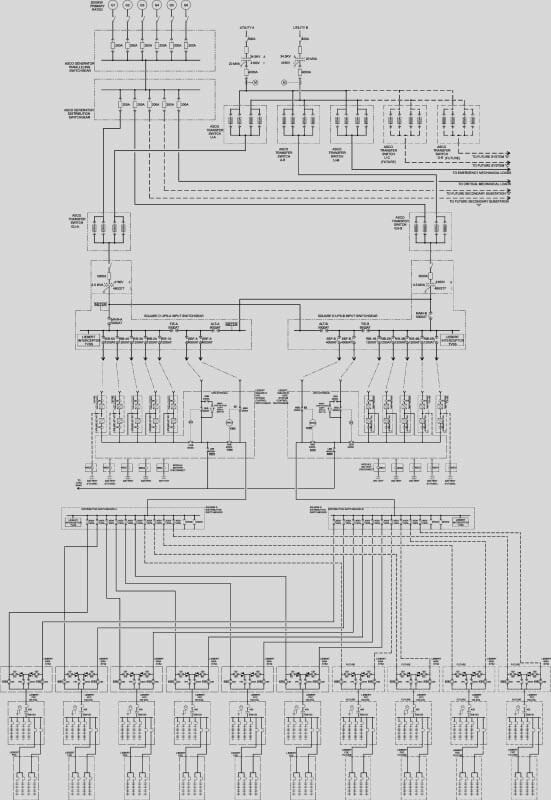
From the grid’s perspective, this creates a coordination problem. A data center appears as a single large load, but internally behaves like many loosely synchronized systems ramping independently. Without a supervisory control layer above equipment-level logic, utilities are forced to plan around worst-case assumptions, slowing interconnections and limiting usable capacity. When that coordination is missing, it can go from theory to incident, like the potential for a cluster of data centers dropping off the grid simultaneously, creating a sudden, large load swing that forces grid operators into defensive action. [6]
The limitation is not sensing. It is orchestration.
What Power Flexibility Actually Means
Power flexibility is not about shutting data centers off. It is about shaping how and when electrical demand changes, without compromising uptime or safety.
In practice, power flexibility requires three core capabilities:
Managing ramp rates rather than only peak load.
Electrical infrastructure must shape how quickly demand rises or falls so facilities can respond to grid stress without compromising uptime.Coordinating actions across systems rather than per device.
Power, cooling, storage, and compute must behave as a unified control surface instead of isolated subsystems with independent rules.Aligning facility behavior with external grid conditions.
Grid signals such as pricing, congestion, and dispatch windows must directly influence when and how energy is consumed or supplied.
These requirements mirror what grid-facing programs increasingly expect from large electrical loads. Google, for example, describes “a new way to reduce our data centers’ electricity consumption when there is high stress on the local power grid” by “shifting some non-urgent compute tasks to other times and locations.” [2] While this example focuses on workload optimization, the same principle extends to power systems themselves, including dynamically switching between grid and on-site energy sources.
These ideas are well understood in theory. What has been missing is a system that can execute them continuously with live facilities, where electrical, thermal, and compute systems interact in real time.
From Monitoring to Control
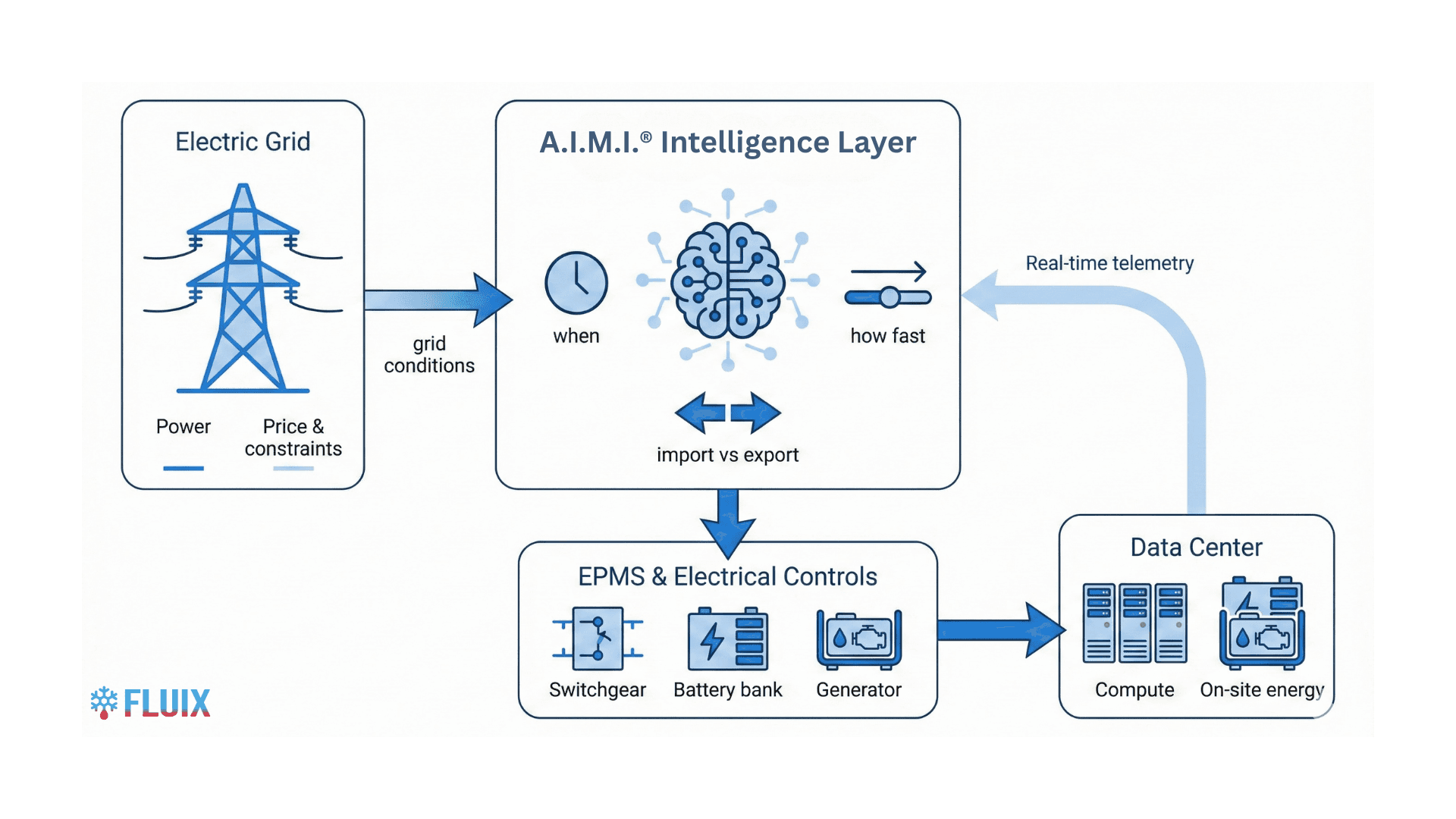
Introducing the Artificial Intelligence for Managing Infrastructure, A.I.M.I.®, an AI-driven software platform that does not replace an EPMS. It sits above it, augmenting rule-based monitoring software with an intelligence that is grid, facility, and compute aware to enable decision-making that goes from reactionary measures to predictive and autonomous actions.
Modern EPMS platforms provide high-resolution telemetry and power quality capture, including events that can be as short as a few milliseconds, which is exactly why EPMS exists as a distinct layer from slower building monitoring. [1] A.I.M.I.® ingests all the EPMS's data, along with signals before and after the meter, to build a real-time model of how power flows through the facility.
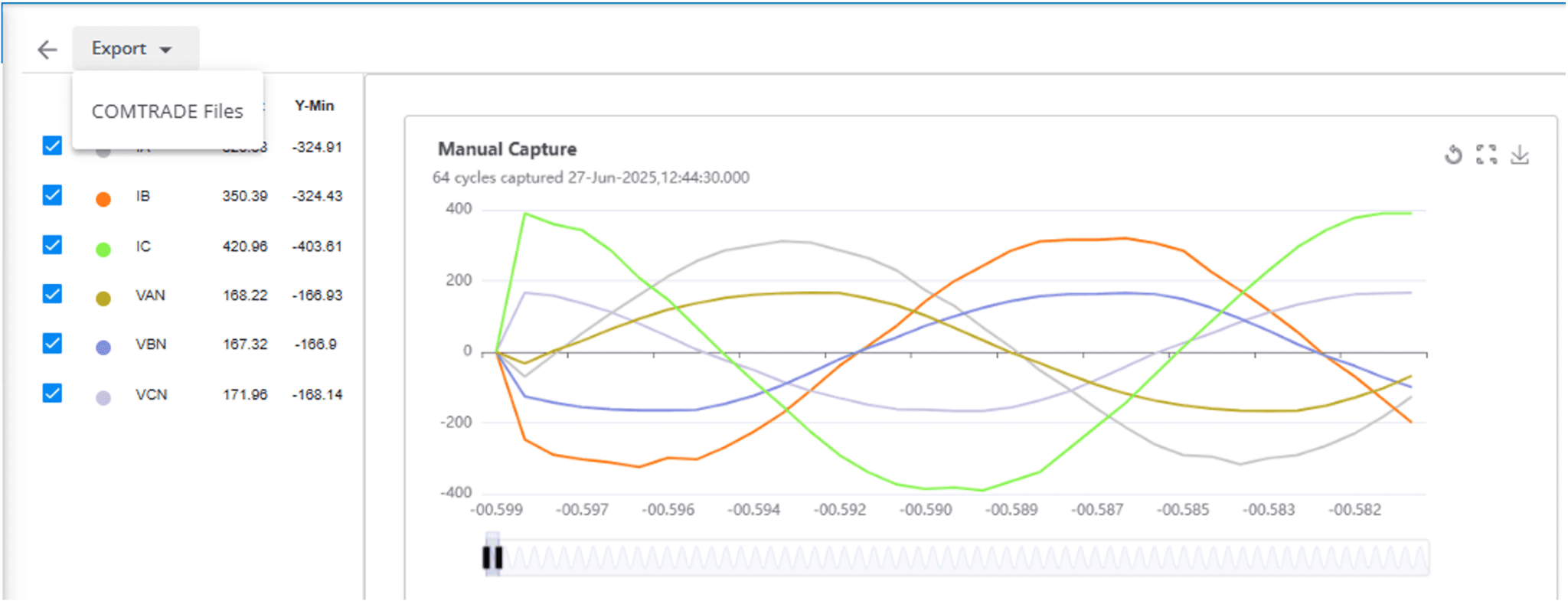
Instead of reacting to alarms, A.I.M.I.® makes proactive, coordinated decisions: smoothing electrical ramps when large workloads start, coordinating UPS, battery, generator, and onsite/offsite power source behavior as a single system, and preserving electrical limits while avoiding unnecessary derates. This is the shift from device-level rules to facility-level behavior shaping, which is also how leading EPMS vendors describe the boundary between “real-time information and preset alarms” versus systems that actually drive automated restoration and reconfiguration. [4]
The result is a facility that behaves less like a fixed load and more like a controllable system.
What A.I.M.I.® Enables in Practice
Power orchestration becomes meaningful only when translated into operational capability inside a live facility. A.I.M.I.® continuously balances three real-time forces: what the grid requires, what the site’s electrical infrastructure can supply, and what the compute workload demands. This coordination unlocks concrete capabilities that extend beyond traditional EPMS visibility.
Power Source Orchestration

A.I.M.I.® enables dynamic switching between grid power and on-site energy resources such as batteries, generators, and distributed renewables. During grid stress events or pricing spikes, a facility can temporarily shift to on-site supply, reducing strain on the grid while stabilizing tenant energy costs. When excess on-site capacity is available, the data center can export energy back to the grid, enabling participation alongside emerging virtual power plant ecosystems.
Grid-Aware Ramp Control

AI workloads create sudden, high-magnitude load ramps that legacy control logic was never designed to manage. A.I.M.I.® anticipates peak events, shapes ramp-up and ramp-down behavior, and can pre-charge battery systems ahead of forecasted grid congestion. This prevents abrupt load swings that destabilize grid operations while preserving uninterrupted compute execution.
Demand Response and Price Intelligence

By continuously ingesting grid pricing, dispatch signals, and constraint conditions, A.I.M.I.® can shift non-urgent workloads away from peak-price windows or reschedule execution to lower-cost periods. This allows data centers to participate directly in demand response programs while maintaining predictable performance for end customers.
Multi-Domain Flexibility Across Power, Thermal, and Compute
True orchestration spans more than electricity alone. A.I.M.I.® coordinates compute scheduling, cooling efficiency, and electrical delivery simultaneously. Workloads can shift to night-time hours when ambient temperatures reduce cooling demand or align with periods of lower grid carbon intensity. The result is continuous closed-loop optimization across the full facility stack. Together, these capabilities transform the data center from a rigid electrical load into a grid-responsive and economically adaptive infrastructure system.
Grid-Aware Power Orchestration
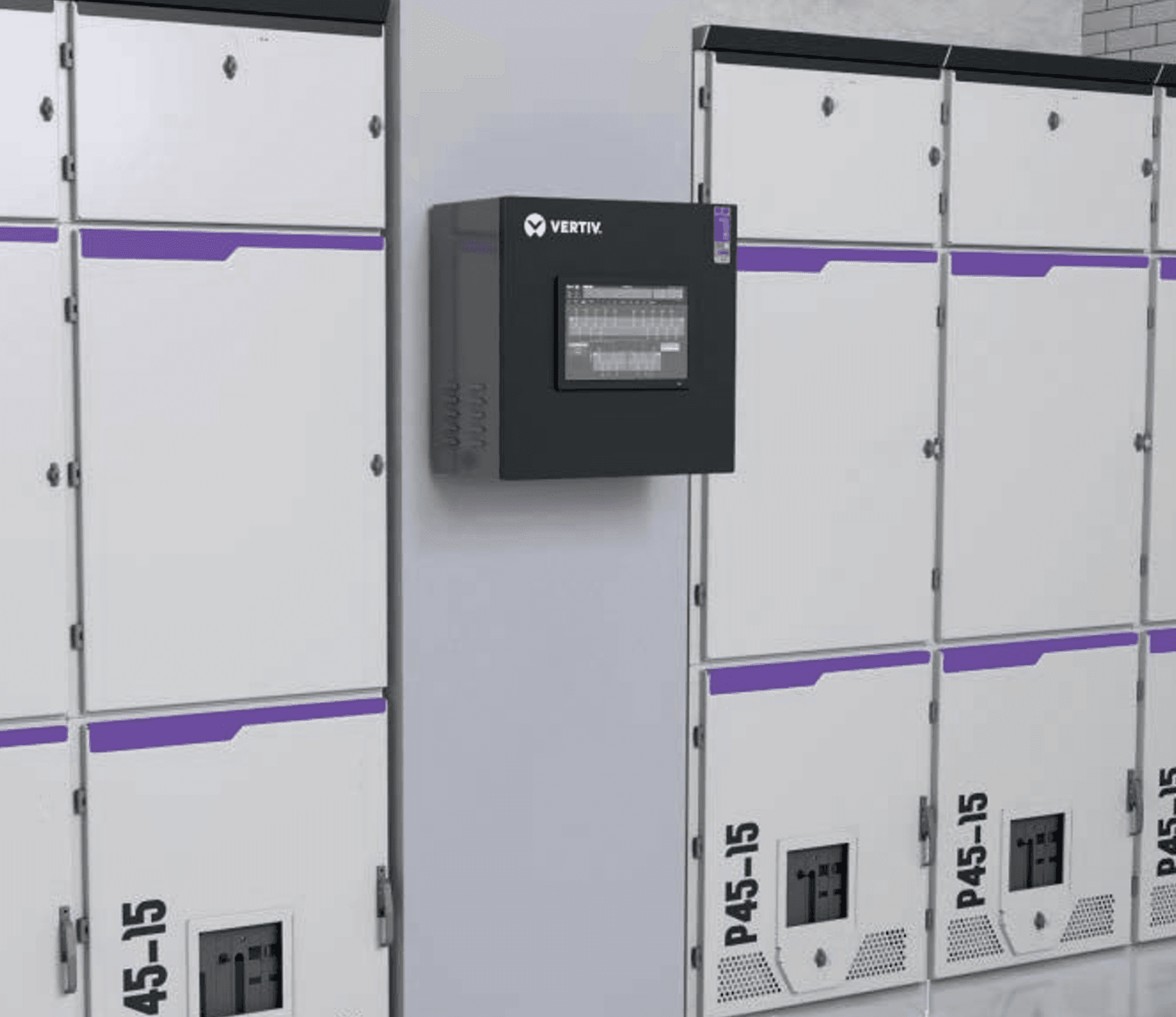
Power flexibility only matters if it aligns with grid conditions. Utilities increasingly rely on demand response, load shaping, and predictable ramp behavior to maintain reliability without overbuilding generation and transmission assets. The direction of travel here is explicit: flexibility tech “can mitigate the impact of data center electricity demand on grid performance and reliability,” especially when it includes temporal and spatial flexibility alongside on-site storage and generation. [3]
A.I.M.I.® incorporates external signals such as pricing, dispatch windows, and grid constraints directly into its control logic. When the grid is stressed, A.I.M.I.® can slow or limit load increases. When capacity is available, it restores operation smoothly. This coordination happens without hard shutdowns or manual intervention, with guardrails that keep critical systems protected while flexible portions of the load are shaped dynamically.
EPMS Today vs. Power Orchestration
Capability | Traditional EPMS | A.I.M.I.® Power Orchestration |
Electrical visibility | Real-time monitoring and alarms | Real-time plus predictive modeling |
Control scope | Device-level, rule-based | Facility-level, coordinated |
Ramp management | Reactive, conservative | Proactive, smooth, constraint-aware |
Grid integration | Limited, manual | Continuous, signal-driven |
Role | Monitoring and protection | Closed-loop power control |
Adapted from industry EPMS capabilities and gaps described in colocation and edge data center research, including vendor and operator perspectives on event capture, millisecond-scale power quality, and the move from alarms to automated restoration and grid-facing flexibility. [1][3][4]
Why This Is New Now
Electrical infrastructure has always been capable of fast response. What changed is the workload.
AI training and large-scale compute introduce step changes that legacy EPMS logic was never designed to manage. At the same time, utilities need large loads to become more cooperative, not just more efficient. Power flexibility emerges at the intersection of those pressures. By treating electrical systems as part of a closed control loop alongside compute and cooling, A.I.M.I.® enables data centers to unlock stranded capacity and participate in grid programs without new hardware, leaning into the same operating logic vendors describe when they say that in the event of a fault the system “automatically reroutes power from a primary source to alternative sources,” [5] while orchestration extends that concept from fault recovery into continuous grid-aware behavior.
From Static Assets to Predictable Grid Participants
Power systems were once the most rigid part of the data center. That is no longer sustainable.
Facilities that can shape their electrical behavior will reduce peak exposure and demand charges, integrate faster with constrained grids, and extract more value from existing infrastructure. Power flexibility is not about turning data centers off. It is about making them intelligible to operators, to utilities, and to the grid. A.I.M.I.® is designed to be the orchestration layer that makes that possible.
To explore how grid-aware power orchestration can be applied at your facility, contact the FLUIX team!
References
[1] Data Center Frontier (Schneider Electric sponsored), Benefits of Integrating BMS and EPMS. https://www.datacenterfrontier.com/sponsored/article/11427160/schneider-electric-benefits-of-integrating-bms-and-epms
[2] Google Cloud Blog, Using demand response to reduce data center power consumption, Oct. 3, 2023. https://cloud.google.com/blog/products/infrastructure/using-demand-response-to-reduce-data-center-power-consumption
[3] RMI, Fast, Flexible Solutions for Data Centers, 2025. https://rmi.org/wp-content/uploads/dlm_uploads/2025/07/Data-Centers-Overview-Deck.pdf
[4] Vertiv, Power management systems for data centers: Enhancing control and efficiency, Aug. 22, 2024. https://www.vertiv.com/en-us/about/news-and-insights/articles/blog-posts/power-management-solutions-for-data-centers-enhancing-control-and-efficiency/
[5] Vertiv, Vertiv™ Energy Power Management System (EPMS) Brochure, 2024. https://www.vertiv.com/globalassets/products/monitoring-control-and-management/software/energy-power-management-systems/vertiv-energy-power-management-systems-brochure-sl-71101.pdf
[6] Data Center Dynamics, Virginia narrowly avoided power cuts when 60 data centers dropped off the grid at once, Mar. 20, 2025. https://www.datacenterdynamics.com/en/news/virginia-narrowly-avoided-power-cuts-when-60-data-centers-dropped-off-the-grid-at-once/
[7] Siemens, WinPM.Net Power Monitoring Guide. https://assets.new.siemens.com/siemens/assets/api/uuid:902ab559-bfb5-46d9-95bd-2b63ead96bb6/ca-si-lv-en-WinPM.Net-App-Guide-SI-EP-1722.pdf
[8] FLUIX AI, A.I.M.I. 1.0: A DRL for Continuous Control of Data Center Cooling, Feb. 2, 2026. https://www.fluix.ai/media/a.i.m.i.-1.0-a-drl-for-continuous-control-of-data-center-cooling.
[9] FLUIX AI, Compute Flexibility: Why AI Data Centers Are Becoming Grid-Aware by Necessity, Jan. 15, 2026. https://www.fluix.ai/media/compute-flexibility-grid-aware-ai-data-centers